
Is an eBay Store subscription worth it? The math
In this guide
- How much does an eBay Store subscription cost?
- When does a Basic Store pay for itself?
- How much does a Store save in your category?
- Do you save more on expensive items?
- Is the Starter Store worth it?
- When is Premium or Anchor worth it?
- Should you pay monthly or yearly?
- How do you open an eBay Store?
- What other eBay fees should you count?
- How do you lower your eBay fees?
- Did eBay’s fees go up in 2026?
- Where does KickSync fit?
- Common questions
TL;DR: The eBay Store that usually pays off is Basic, at $21.95 a month on a yearly plan. It cuts eBay’s selling fee in most categories from 13.6% to 12.7%. If you’re doing $10,000 a month in sales, that’s about $90 a month back, or $68 after the subscription: roughly $800 a year. Sell electronics, cameras, or computers and it’s more like $400 to $600 a month. And if you keep more than about 310 listings up, the listing fees you stop paying cover the plan on their own.
An eBay Store subscription is worth it when it saves you more in fees than it costs. For a Basic Store on a yearly plan, in most categories, that happens at about $2,440 a month in sales, or as soon as you keep more than about 310 listings up, whichever comes first. Starter rarely pays for itself, Premium beats Basic past about 1,150 listings, and Anchor is for catalogs past 12,000 or so.
Every price and fee here comes from eBay’s US pages, as of November 2026.
How much does an eBay Store subscription cost?
eBay has five Store plans. You choose monthly or yearly renewal when you subscribe, and either way eBay bills you each month; yearly is just cheaper per month (eBay’s Store subscriptions and fees).
| Plan | A month, yearly plan | A month, monthly plan | Listings a month with no insertion fee | Insertion fee after that | Final value fee, most categories |
|---|---|---|---|---|---|
| No Store | None | None | 250 | $0.35 | 13.6% |
| Starter | $4.95 | $7.95 | 250 | $0.30 | 13.6% |
| Basic | $21.95 | $27.95 | 1,000 fixed price, plus 10,000 in select categories | $0.25 | 12.7% |
| Premium | $59.95 | $74.95 | 10,000 fixed price, plus 50,000 in select categories | $0.10 | 12.7% |
| Anchor | $299.95 | $349.95 | 25,000 fixed price, plus 75,000 in select categories | $0.05 | 12.7% |
| Enterprise | $2,999.95 | Not offered | 100,000 fixed price, plus 100,000 in select categories | $0.05 | 12.7% |
A few things the table can’t hold:
- The select categories for the extra fixed-price listings are collectibles, sports trading cards, collectible card games, books and magazines, movies and TV, music, video games, stamps, crafts, and party supplies.
- Auctions get their own allowance on Basic and up, in a set list of categories, and their insertion fees are credited back when the auction ends in a sale. Past the allowance, auctions cost a little more to list than fixed price on Premium and up.
- The final value fee is charged on the total of each sale. With Basic or higher, the rate runs up to $2,500 an item; with no Store or Starter, up to $7,500. Above that, it’s 2.35%. Many categories have their own rates, which are further down.
- Extras: Basic and up get a quarterly coupon for eBay-branded shipping supplies and eBay’s promotional pricing tools.
Renewing listings count every month
Good ’Til Cancelled listings renew each calendar month, and every renewal comes out of your allowance. Once the allowance is used up, each renewal pays the insertion fee again (eBay’s selling fees). So a seller with 600 listings and no Store pays for 350 of them every month, sold or not. That’s the part of the Store math that’s easy to miss.
When does a Basic Store pay for itself?
Basic is where the math changes, because it’s the first plan with a lower final value fee. In most categories it saves 0.9% of every sale, and it lifts your allowance from 250 listings to 1,000. So Basic pays for itself when:
0.9% of your monthly sales + $0.35 for each listing over 250 is more than $21.95
- With 250 listings or fewer, that takes about $2,440 a month in sales on a yearly plan ($21.95 ÷ 0.009), or about $3,110 on a monthly one.
- With more than about 310 listings, the listing fees alone cover it, whatever you sell: 63 listings at $0.35 is $22.05. On a monthly plan, it’s about 330.
“Sales” means what buyers pay you. eBay charges its final value fee on the total amount of the sale, which includes the item price, shipping, handling, and sales tax. If you’d like to try your own numbers, FlipperTools’ “Should I get an eBay Store?” page works through the same break-even with current prices.
eBay fees with a Store vs no Store: three sellers
Here’s a month of eBay fees for three sellers in most categories, all selling fixed price with Good ’Til Cancelled listings, on yearly plans. It counts the final value fee, insertion fees, and the plan. The per-order fee is the same on every plan, so it’s left out.
| Part-time | Steady | Full-time | |
|---|---|---|---|
| Sales a month | $1,500 | $4,000 | $10,000 |
| Listings up | 200 | 600 | 1,500 |
| No Store | $204.00 | $666.50 | $1,797.50 |
| Starter | $208.95 | $653.95 | $1,739.95 |
| Basic | $212.45 | $529.95 | $1,416.95 |
| Premium | $250.45 | $567.95 | $1,329.95 |
| Best pick | No Store | Basic: $136.55 a month less | Premium: $467.55 a month less |
- The part-time seller would save $13.50 a month in fees with Basic, which doesn’t cover the $21.95. Keep it for bubble wrap.
- The steady seller saves $36 in final value fees and $122.50 in insertion fees. Most of it is the listings: trimmed to 250 listings, Basic would save them only $14.05 a month.
- The full-time seller outgrows Basic’s 1,000 listings. Premium costs $38 more, and Basic would charge $125 for the other 500.
How much does a Store save in your category?
The 0.9% is the cut in most categories. Some get far more, and a few get nothing. Here’s the final value fee with no Store (or Starter) against Basic and higher, and what the cut is worth on $10,000 of sales a month, before the subscription (eBay’s Store selling fees):
| Category | No Store or Starter | Basic and up | Saved on $10,000 |
|---|---|---|---|
| Most categories: clothing, home and garden, toys, sporting goods, video games | 13.6% | 12.7% | $90 |
| Sports trading cards, collectible card games, comic books | 13.25% | 12.35% | $90 |
| Cameras, cell phones, most consumer electronics (accessories: 12.7%) | 13.6% | 9.35% | $425 |
| Laptops, desktops, tablets, monitors, printers, video game consoles | 13.6% | 7.35% | $625 |
| Coins and paper money (not bullion) | 13.25% | 9% | $425 |
| Stamps | 13.6% | 9.7% | $390 |
| Musical instruments and gear (not guitars and basses) | 13.6% | 10.35% | $325 |
| Watches, parts, and accessories (up to $1,000 an item) | 15% | 12.5% | $250 |
| eBay Motors parts and accessories (up to $1,000 an item) | 13.6% | 11.5% | $210 |
| Jewelry (up to $5,000) and women’s bags and handbags (up to $2,000) | 15% | 13% | $200 |
| Athletic shoes, $150 and up | 8% | 7% | $100 |
| Books, movies and TV, music (vinyl records: first row) | 15.3% | 15.3% | $0 |
| Guitars and basses | 6.7% | 6.7% | $0 |
Book, movie, and music sellers get no fee cut at all. For them a Store is all about listings, and Basic’s extra 10,000 fixed-price listings in those categories make it a cheap home for a big shelf of media: 2,000 books with no Store cost $612.50 a month in insertion fees.
Do you save more on expensive items?
Yes, much more. Without a Store, the 13.6% rate runs all the way to $7,500 an item. With Basic or higher, 12.7% stops at $2,500, and everything above that is 2.35%. Here’s one $5,000 sale in most categories:
| No Store or Starter | Basic or higher | |
|---|---|---|
| Up to the rate break | 13.6% of $5,000: $680.00 | 12.7% of $2,500: $317.50 |
| Above it | None | 2.35% of $2,500: $58.75 |
| Per-order fee | $0.40 | $0.40 |
| eBay’s fee | $680.40 | $376.65 |
That one sale saves $303.75, more than a year of Basic on the yearly plan ($263.40). If you sell even a few big-ticket items a year, count them separately: they can settle the question alone.
Is the Starter Store worth it?
Rarely, on fees alone. Starter has the same final value fees as no Store and the same 250 listings. The only fee difference is $0.30 instead of $0.35 for each listing past 250, so it takes about 100 extra listings to cover the $4.95. By then Basic saves more. What Starter buys is the Store itself, and eBay says some Store benefits aren’t included with it.
When is Premium or Anchor worth it?
Premium has the same final value fees as Basic, so the only question is listings. It costs $38 a month more on a yearly plan, and Basic charges $0.25 for each fixed-price listing past its 1,000. Premium wins past about 1,150 listings (about 1,190 on monthly plans), not counting listings in Basic’s select categories, which have their own 10,000.
Anchor costs $240 a month more than Premium. Premium charges $0.10 a listing past 10,000, and Anchor covers you to 25,000, so it evens out at about 12,400 listings. Anchor also comes with dedicated phone and email support, which may be worth something on its own. Enterprise, at $2,999.95 a month on a yearly plan only, beats Anchor at around 79,000 listings.
Should you pay monthly or yearly?
Yearly is cheaper: $72 a year less on Basic. But cancel or downgrade a yearly plan before its last month and eBay charges an early termination fee, the months left times the plan’s monthly price, divided by three. On Basic with 12 months left, that’s $87.80. Monthly plans have none (eBay’s Stores Subscription Terms).
A sensible way in: start monthly, look at your fees after a month or two, then switch to yearly. eBay treats monthly to yearly as an upgrade, so there’s no fee for the switch and the rest of your month is credited.
Three timing details from eBay’s terms:
- Your first partial month is prorated, but you get the whole month’s listing allowance whenever you sign up.
- Downgrades and cancellations take effect after the end of the calendar month; you keep the plan, and pay for it, until then.
- Listings created before your subscription starts don’t get Store final value fee rates.
How do you open an eBay Store?
Steps as of November 2026, from eBay’s help on opening a Store:
- Go to eBay’s Choose a Store Subscription page (ebay.com/sub/subscriptions).
- Find the plan you want and select Select and review.
- Choose yearly or monthly renewal, and enter a name for your Store.
- Select Submit order.
You’ll need an eBay seller account with a checking account linked for payouts. To change plans later, use Change subscription on the Manage subscription page, which also has Change to yearly and Change to monthly (managing your eBay Store). To cancel, select Cancel subscription on your Subscriptions page. Fixed-price listings may move to standard fees after that (closing your eBay Store).
What other eBay fees should you count?
A Store changes the final value fee and insertion fees. These stay the same with or without one (eBay’s selling fees):
- Per-order fee: $0.40 on orders over $10, $0.30 on orders of $10 or less.
- International fee: 1.65% of the total sale when the buyer’s address or the delivery address is outside the US. It isn’t charged when you offer eBay International Shipping on eligible listings.
- Currency conversion: 3.25% when eBay converts funds for a listing or sale on another eBay site in a different currency. It went up from 3% on October 14, 2026; Value Added Resource has the details.
- Below Standard: if your account falls below eBay’s seller standards, eBay adds 6% of each sale’s total to your final value fees the next month, and 7% after four months in a row. That’s more than six times what a Basic Store saves in most categories. Above Standard and Top Rated sellers don’t pay it.
- Promoted Listings: optional, at a percentage of the sale you choose. Our guide to eBay Promoted Listings shows how to build the ad fee into your price, and its formula works with Store rates too.
How do you lower your eBay fees?
- Match the plan to your size, using the break-even lines above.
- End listings that renew without selling. Each Good ’Til Cancelled renewal uses up allowance or costs an insertion fee. If something’s on its ninth renewal, it’s either priced wrong or it’s decor.
- Stay Above Standard, and offer eBay International Shipping on eligible listings. The surcharge and the 1.65% international fee each cost more than a Store saves in most categories.
Did eBay’s fees go up in 2026?
The US selling fee change we’ve tracked this year is the currency conversion charge, up from 3% to 3.25% on October 14, 2026. The Store prices and final value fees above are eBay’s as of November 2026. Promoted Listings changed too, on January 13, 2026: general ads are now charged when any buyer buys within 30 days of any click on the ad (more in our Promoted Listings guide).
Where does KickSync fit?
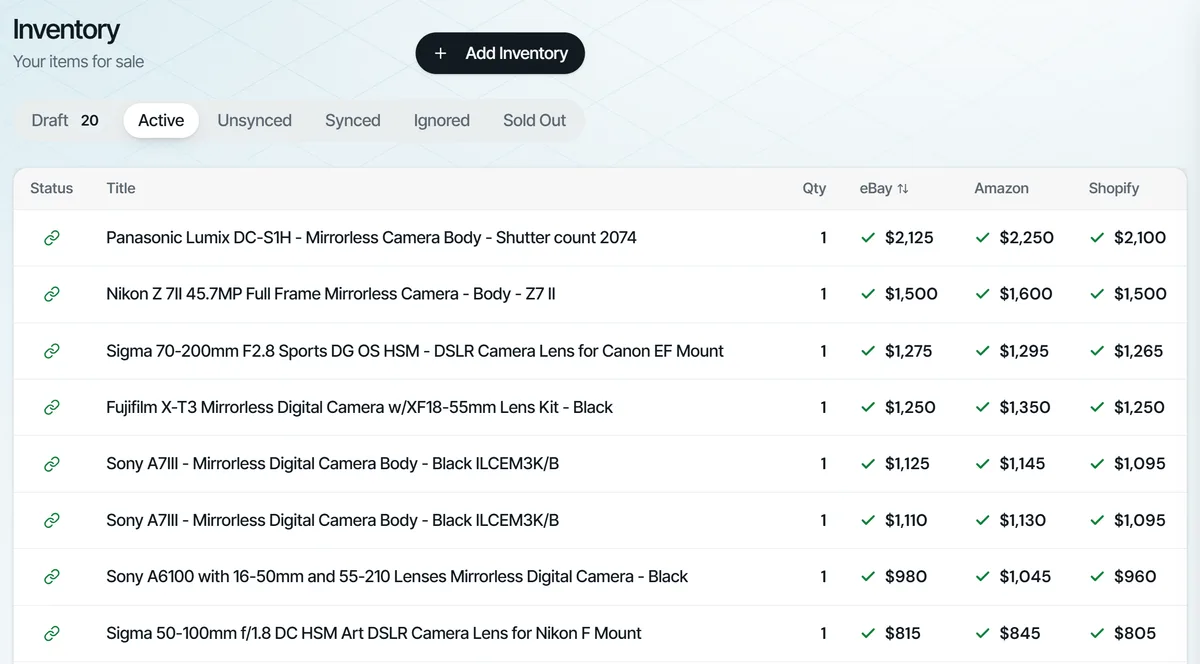
A Store lowers what eBay takes from each sale. It doesn’t bring you more buyers. If you’re running these numbers because sales have slowed, the other half of the answer is reaching buyers who don’t shop on eBay, and that’s the job KickSync does. Keep listing on eBay, turn on Auto-Publish, and KickSync lists your items in your Shopify store with their photos, price, and details. After that, quantities stay in sync, and a sale in either place updates the other in minutes. Each place can keep its own price.
KickSync is priced the way a Store is: a flat monthly plan, with no per-order fees. eBay’s own fees still apply. And if you list from KickSync, it uses the eBay defaults you set once, your Store category included. More on how it works for eBay sellers, and the plans are on our pricing page.
Common questions
Is it cheaper to have a Store on eBay?
Only past the break-even point. On a yearly Basic plan in most categories, that’s about $2,440 a month in sales or more than about 310 listings. Below both, the subscription costs more than it saves.
How much does eBay take from a $1,000 sale?
Without a Store, in most categories, $136.40: 13.6% of $1,000 plus the $0.40 per-order fee. With a Basic Store or higher, $127.40. The $1,000 is the total the buyer pays, shipping and sales tax included.
Do unused Store listings roll over?
No. The allowance resets on the first of each month, and whatever you didn’t use is gone.