
Amazon FBA fee changes 2027: who pays more, what to do

In this guide
TL;DR: FBA fees go up $0.19 a unit on average on January 15, 2027, but nobody sells the average item. Items under $10 in media, automotive, computers, compact appliances, and musical instruments take the biggest hit: a $9.99 DVD pays $1.33 more to ship. Small items priced over $50 go up about $0.70. From February 1, stock older than six months costs more to store. Check your own items in Amazon’s Fee Change Comparison dashboard, then fix the prices and old stock it flags.
Amazon’s 2027 FBA fee changes raise the average fulfillment fee by $0.19 a unit from January 15, 2027, which Amazon puts at about 0.8% of the average item’s price. The storage and low-inventory fee changes wait until February 1. Amazon announced all of it on November 5, 2026, in a letter to sellers. Fees and rules here are as of November 2026.
What are Amazon’s FBA fee changes for 2027?
Here’s how much the average standard-size item goes up, per unit, from Amazon’s 2027 fee summary:
| Item price | Small standard | Large standard |
|---|---|---|
| Under $10 | +$0.20 | No change (apparel +$0.08) |
| $10 to $50 | +$0.40 | +$0.12 |
| Over $50 | +$0.70 | +$0.47 |
- The 3.5% fuel and logistics surcharge isn’t going anywhere. Amazon’s rate tables leave it out, so multiply any fee you see there by 1.035 to get what you’ll actually pay.
- Peak rates end January 14, the day before the new ones start. Compare the new fees with 2026’s non-peak rates. Next to what you’re paying this holiday season, the rise looks smaller than it is.
- Bulky and extra-large items get new size tiers. Amazon’s rule of thumb is that smaller and lighter pays less, and bigger and heavier pays more. Two new handling fees come with them: one for large flat items (under 4 inches thick, with a middle side of 25 inches or more), and one for anything whose middle side is over 43 inches.
Which sellers are hit hardest?
Two groups: cheap items in five categories, and small items priced just over $50.
Items under $10 in five categories
From January 15, these five fee categories lose the low-price FBA rates, so their items under $10 pay the $10 to $50 rates instead:
- Media (books, DVDs, music, software, and video)
- Automotive and Powersports
- Computers
- Compact Appliances
- Musical Instruments and AV Production
That’s $1.29 to $1.38 more a unit on small standard items, and $0.88 to $1.01 on large standard ones, before the surcharge. Used book and DVD sellers will feel it most. Media already pays a $1.80 closing fee and a 15% referral fee on every sale, so there wasn’t much left to give. Here’s a $9.99 DVD that weighs 2 to 4 oz:
| 2026 non-peak | From January 15, 2027 | |
|---|---|---|
| Referral fee (15%) | $1.50 | $1.50 |
| Closing fee | $1.80 | $1.80 |
| Fulfillment fee, with the 3.5% surcharge | $2.58 | $3.91 |
| Left before the item’s cost, inbound shipping, and storage | $4.11 | $2.78 |
That’s about a third less on every sale, on an item that didn’t leave much to begin with.
Small items priced just over $50
Crossing $50 gets pricier. The gap between the $10 to $50 rate and the over-$50 rate grows from $0.26 to about $0.56 on standard-size, non-apparel items. A price of exactly $50 still gets the lower rate. So, at a 15% referral fee, anything from $50.01 to about $50.68 now nets you less than $50 would. That first penny over $50 costs about 58 cents.
How do storage and low-inventory fees change?
On February 1, 2027, the storage utilization surcharge goes away, and the aged inventory surcharge gets folded into one unified monthly storage fee priced by age. These are the rates per cubic foot for standard-size items from January to September (the old column leaves out the utilization surcharge):
| Age of the stock | Before February 1, 2027 | From February 1, 2027 |
|---|---|---|
| 0 to 180 days | $0.78 | $0.78 |
| 181 to 270 days | $1.28 to $2.28 | $2.78 |
| 271 to 330 days | $6.23 to $6.48 | $6.68 |
| 331 to 365 days | $6.68 | $6.68 |
| 366 to 455 days | $7.68 | $7.68 |
| 456 days or more | $8.68 | $8.68 |
October to December adds $1.62. Clothing, shoes, bags, jewelry, and watches get a lower $1.78 at 181 to 270 days. In the two oldest tiers, Amazon charges $0.78 a cubic foot plus $0.30 a unit (366 to 455 days) or $0.35 a unit (456 days or more) when that comes to more than the table’s rate. Seller Essentials’ comparison puts the old and new rates side by side.
The jump at 181 days looks scary until you remember it’s per cubic foot. In Amazon’s own example, a unit that takes up 0.05 cubic feet costs about ten cents more a month once it’s past 180 days. Where it bites is bulky stock, and anything past 270 days.
From February 1, the low-inventory-level fee applies only when an item has under 28 days of supply, measured on what actually shipped in both the four weeks before Amazon’s check and the four weeks after it. Anything that shipped fewer than 20 units in the past seven days is exempt, which covers most one-offs and slow movers.
Are Amazon’s referral fees going up in 2027?
No, not across the board. Amazon’s summary lists two referral changes, and neither is a rise. 3D printers pay 12% on the first $200 and 5% on the rest, so the pricier ones pay less than before. Amazon Renewed items in eligible categories pay a promotional 10% through October 18, 2027.
What should you do before the new fees start?
- Run your own numbers. The Fee Change Comparison dashboard, under Profit Analytics in Seller Central, shows the change for your whole account and for each product. Look at total dollars, not percentages: a big jump on something you sell twice a year can matter less than a dime on your best seller. To test a single item without signing in, Goat Consulting’s FBA calculator has a 2027 rate option.
- Reprice items under $10 in the five categories. Pricing at $9.99 doesn’t buy them a lower fulfillment fee anymore. A $9.99 DVD and a $12.99 DVD of the same weight both pay $3.78 before the surcharge.
- Check prices just above $50. Move anything from $50.01 to about $50.68 down to $50, or up past that range.
- Sell through or remove old stock. Anything received by about August 4, 2026 will be over 180 days old on February 1. Start with the bulky stuff and anything getting close to 271 days.
- Find a better home for items that no longer pay. Some will earn more shipped from your own shelf, on Amazon or on eBay. Count postage, packing, and your own time before you move anything.
What isn’t known yet?
Two things. Amazon’s 2027 fulfillment tables stop at October 14, 2027, so the late-2027 peak rates aren’t out yet. And Amazon says it will keep reviewing the 3.5% surcharge “as conditions change”, which doesn’t commit to anything either way. PPC Land’s breakdown covers what we’ve skipped, including the new oversize tiers.
Where does KickSync fit?
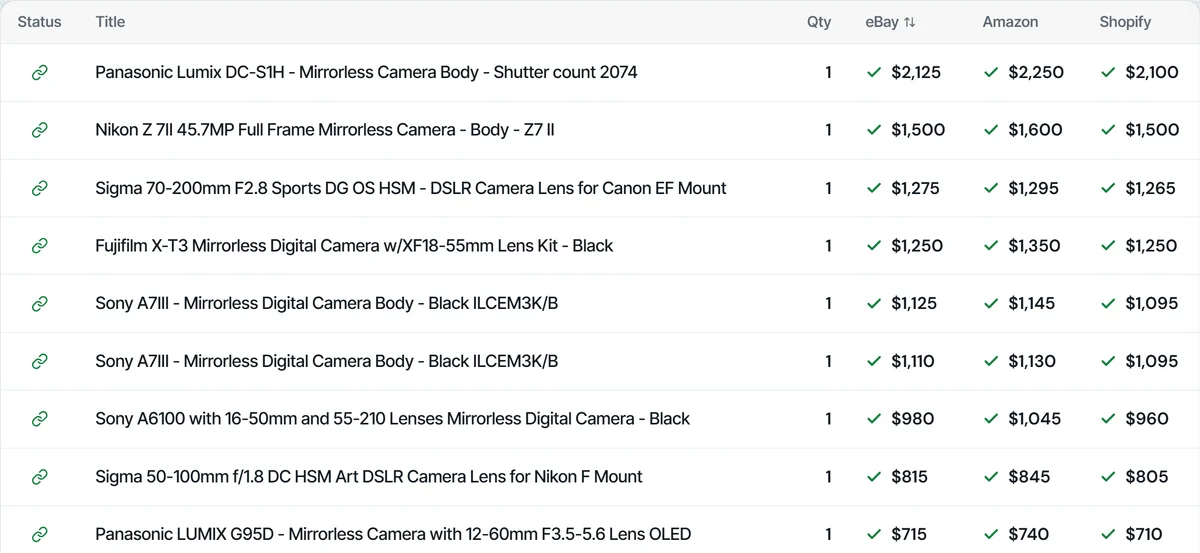
If all this has you thinking some items should sell in more than one place, that’s the job KickSync does. Keep working on Amazon, and your items list on eBay and in your Shopify store automatically, with their photos, price, and details. Each place can keep its own price. After that, quantities stay in sync, and a sale anywhere updates your other channels in minutes.
Plans are a flat monthly price with no per-order fees; each marketplace’s own selling fees still apply. More on how it works for Amazon sellers.